
Changemakers: Thing Thing
18-Nov-2026
In turning Detroit’s discarded plastic into furniture, clocks and public art, Thing Thing shows how process itself can be the point. “Our primary goal is the joy of making.”
Interview #16 in the Changemakers series
In this interview, we spoke with ⅔ of Thing Things’s co-founders – Rachel Mulder and Simon Anton – about the interplay of experimentation with a practice that doesn’t have to pay its own way; about responding to critiques of working with plastic; and about what they’ve learned through projects from Detroit to Hawaii.
This is the 17th in our Changemakers series – interviews with leaders in sustainable, circular and regenerative approaches in the furniture industry. Our aim is to uncover the nuts and bolts of how each leader is driving change, the potential it holds, and why it matters to the industry.
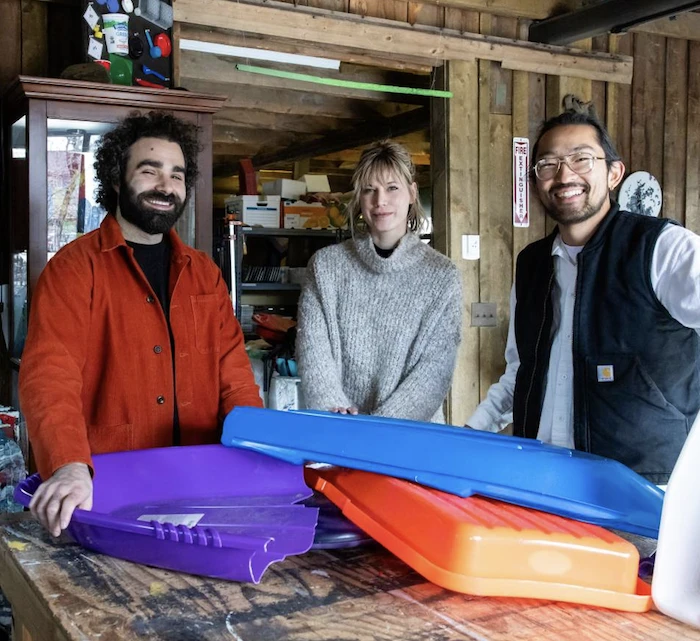
(left to right) Simon Anton, Rachel Mulder and Eiji Jimbo, co-founders of Thing Thing
mebl: Hi Rachel, Hi Simon- before we ask how you got started, let’s first ask – What is Thing Thing today?
Rachel Mulder: We’re harder to define than a typical design studio! Thing Thing is a collective experiment in developing expertise and authorship across the whole making process. Much of our work involves post-consumer, hand-recycled, high density polyethylene plastic from Detroit.
We also emphasize working with others, including community members, through workshops and talks. Building relationships and conversations around public art and materials is very important to us.
Simon Anton: Thing Thing is a practice built on 15 years of friendship. That has been one of our most generative dynamics, as each of us brings unique experiences – when we come together,we make really special things!
Each of us has a ‘day job’ or side practice. So, since we don’t need Thing Thing to pay for our lives, we can be more experimental. We feel almost indulgent saying “We’re doing a project to explore a material” rather than working within a set budget. Of course, as a business, we want to be profitable and avoid waste. But we also are committed to Thing Thing as a more truly exploratory practice.
mebl: So where did the name Thing Thing come from?
Rachel: ‘Thing Thing’ comes from a night out at our favorite pool bar in Ann Arbor. We were sitting at a table scribbling out as many names as we could imagine. At the time, small architecture studios were using terms like "studio,' 'atelier,' or 'office' … and we were looking for something that was more honest about what we were trying to do - not quite architecture, not quite art, not quite objects - just things.
Our partner Jimbo then noted that, in Japanese, if you say something twice it makes it cute – therefore: Thing Thing!
mebl: Now going back in time! Tell us about yourselves and how you landed working together?
Simon: Rachel, Jimbo and I met as architecture students at the University of Michigan.. We were all engaged in experimental making – processes that separated us from a traditional architectural way of working.
Our three paths crossed through the opportunity to work with our professor, Thom Moran, on a research and fabrication project for the 2012 Venice Architecture Biennale. Our focus was on making things from plastic waste. We bridged that with a deep hands-on engagement with the materials and low-fi, hacked machinery for the process.
mebl: What was the intent of that project?
Rachel: Our foundational question was – What is free and readily available and how can we make something out of it? Detroit has a long history of automotive manufacturing. That industry generates a lot of plastic as byproduct waste.
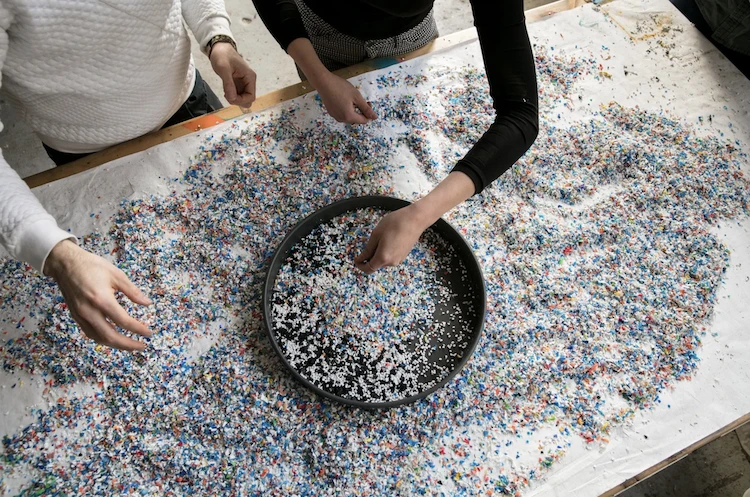
So we focused our hands, our brains, and our tools on a bunch of trash. At a local recycling center, we filled an entire 16-foot truck with post-consumer laundry detergent bottles. We washed and shredded all of them, and landed with hundreds of pounds of plastic sorted by color.
We recycled the plastic by hand – what we call an ‘impoverished material process’ – in order to promote an optimistic attitude about what is possible with very few resources for both design and Detroit. This evolved into Thing Thing.
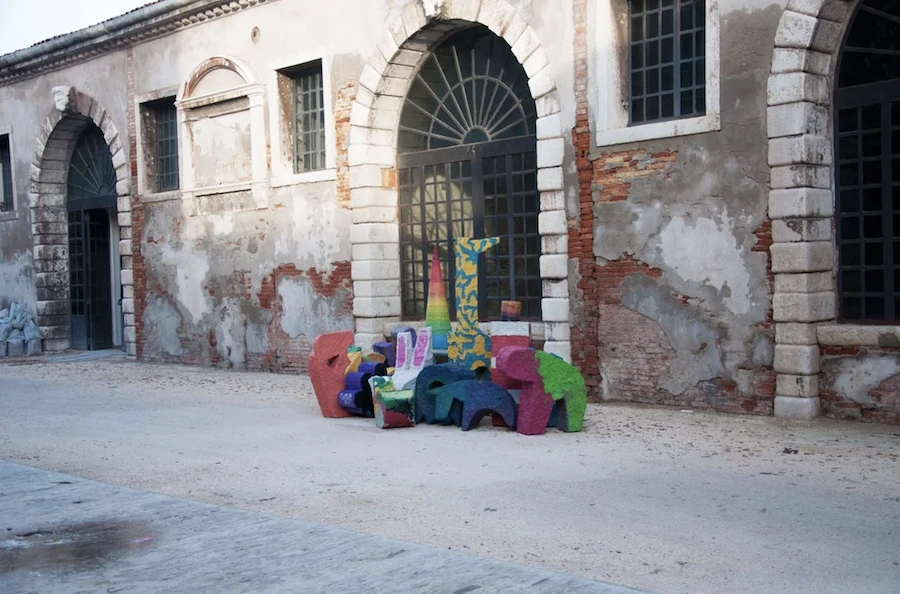
Making Friends is a room-sized puzzle, comprised of friendly pieces. Each piece, or “friend,” can stand alone as an enigmatic domestic object – or it can be a part of a larger whole.
mebl: Walk us through a few illustrative projects.
Rachel: Transforming Trash is a good example. It’s a community plastic recycling lab where local youth learn how to collect, shred, melt, and cast plastic into functional art. We also have a partnership with an arts campus in Breckenridge, Colorado, where we give talks and help them build a plastic workshop that’s safe and productive.
Some of our work is product-based. We made a side table, for example, with Floyd, a Detroit-based furniture company. The table featured plastic waste from the auto industry that would otherwise have gone to a landfill. This was paired with Floyd’s signature steel legs.
Then there’s our Pan Fried Stools. They’re also made from found plastic, including automotive waste, product rejects, and recycling-center finds. We melt the plastic and outfit the stools with hardwood legs.
Our Future Foam project turns scrap foam from transportation interiors into benches. Our clocks are where we experiment most freely and express the material by hand-blending the plastic into swirling, planetlike patterns of color and texture.
Across the clocks, the public sculpture proposals, and the stools, the work comes from the same process: learning a material well enough to make something new from it.
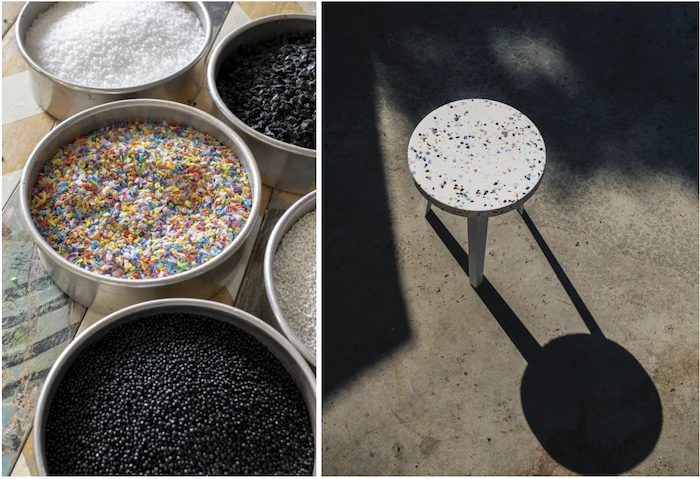
Thing Thing’s Side Table pair the studio’s experimental materials with Floyd’s refined design. Each surface contains 7.5lbs of 100% post-industrial plastic from Detroit-area automotive and toy factories – that would otherwise land in the landfill.
mebl: The Transforming Trash initiative sounds fascinating!
Simon: It’s on the Big Island in Hawaii. Transforming Trash is a multi-organization collaboration that creates community plastic recycling workshops and public art. Before launching this program in Hawaii, we ran a smaller pilot with a local organization in Detroit – building pocket parks by working with youth and community members to source, melt and cast used plastic, then craft and install functional public art in the parks.
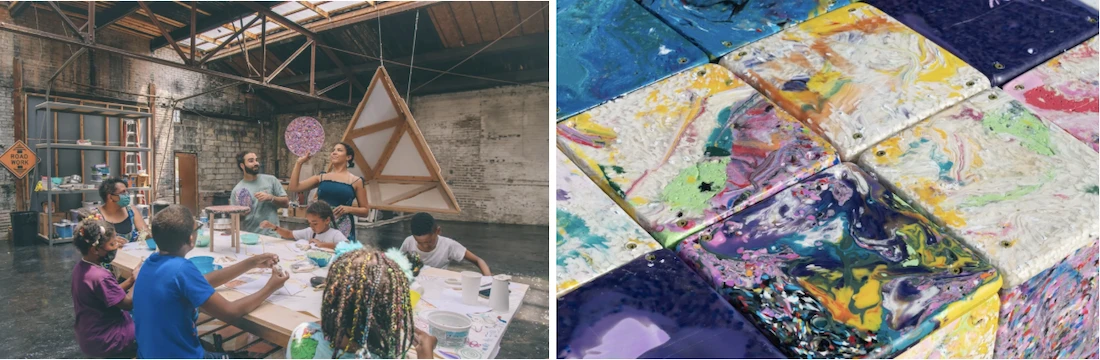
Kids aged 4-18 transformed old detergent bottles into plastic tiles which were then used for a bench in the local community park.
mebl: Where does your plastic waste come from?
Simon: It’s a mix of community plastic and industrial plastic. Recyclers buy bulk plastic waste and process it into regrind.We source it by the pallet. We mix a neutral base with colorful pieces from the community – outdoor and kids’ furniture, toys, children’s slides, etc – which gives our work a terrazzo-like look. We’ve moved away from post-consumer plastics such as detergent bottles since many are blow-molded, which makes them harder to recast.
Rachel: We’ve been lucky in finding the right partners. Most recycling companies don't want people popping in and filling garbage bags with their plastic – even though it’s basically trash!
mebl: Have you faced criticism for working with plastic?
Simon: We’re clear that we aren’t trying to solve the plastic waste problem. Our pieces use a lot of material, but plastic is a much bigger challenge than anything an art project can fix. We see our role as storytelling and creating a voice of optimism. This is an example of how NOT having a business model – centered on production – is useful, because it lets us take on projects with different narratives.
mebl: Tell us about telling a deeper story?
Simon: On the Big Island of Hawaii, our original research was with ocean plastics that wash up on the beach at Kamilo, at the southern tip of the island. We began collecting, sorting, and documenting the small chips of material worn down by the ocean.
But it quickly became a bigger exploration of interconnectedness. Gathering plastic became a way to explore the island’s different ecosystems. Lava flows that formed the island became our formwork for relief molds. We filled them with plastic, shells, wood, and sand. Working with local experts, we developed a method of melting these forms over open fires. These objects don’t try to solve a problem but rather try to tell a deeper story.
Rachel: Our primary goal is the joy of making – to be creative and make things. But attitudes toward plastic is an intellectually engaging conversation, and an important one, so we’re ready to have it.
Only an estimated 9% of US plastic waste is recycled. For the time being, at least, it is part of daily life. Plastic is engineered to perform in a certain way, which is why we store food in it and ship medicine in it. It’s a reality, and it’s not going to go away just by taking a moral high ground.
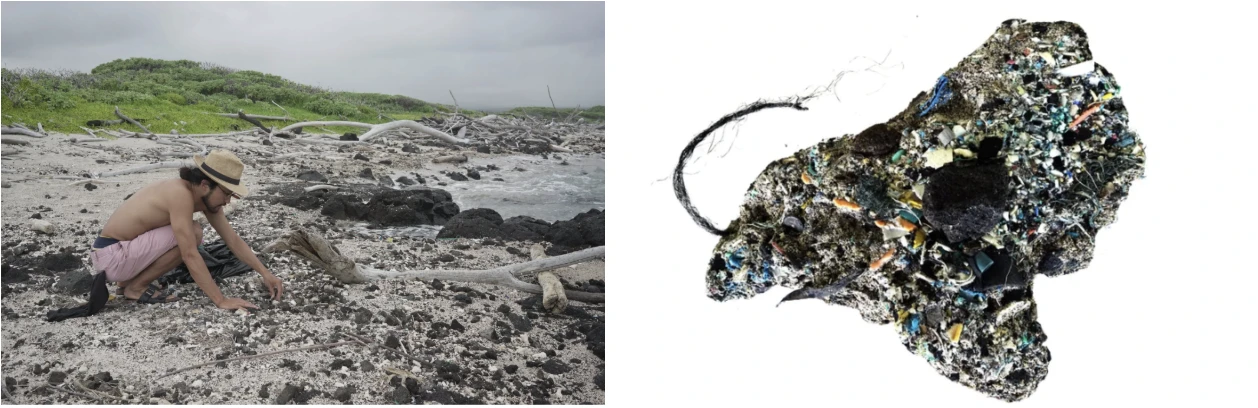
Relief molds cast from Big Island lava flows, filled with beach plastic, shells, wood, and sand, gathered from Kamilo Beach, where ocean plastic washes ashore.
mebl: What’s the next thing for Thing Thing?
Simon: I’m a lifelong educator, so more community collaboration is on the horizon. We’re making a public sculpture with an organization that pairs high school students with artists. Projects like that inspire me.
Rachel: I’d really like to work with building industry waste, especially from buildings being demolished. Demolition often smashes everything and treats expensive materials as trash. There’s a lot to grasp there.