
Changemakers: Loose Parts
29-Sep-2026
By designing furniture and kitchens for the long haul, Jennifer June of Loose Parts makes sure disassembly is built in from the start. “I love interior design,” notes Jennifer, “but I didn't want to contribute to the cycle of install, rip out, install, rip out.”
Interview #16 in the Changemakers series
In this interview, we spoke with Jennifer about her design system, what she's learning from the next generation of designers and why what's worth keeping should be easy to fix. "Anything in your home that's older than you has stayed because it has kept its value," she says, "emotionally, structurally, or because the design still works."
This is the 17th in our Changemakers series – interviews with leaders in sustainable, circular and regenerative approaches in the furniture industry. Our aim is to uncover the nuts and bolts of how each leader is driving change, the potential it holds, and why it matters to the industry.

Jennifer June, Founder of Loose Parts
mebl: Hi Jennifer! Tell us about yourself - who were you before becoming a furniture innovator?
Jennifer June: I’ve always liked making things with my hands! I grew up in San Diego, but got to spend my summers as a kid in Costa Rica on my mom’s family's farm. It was formative for me – seeing my aunts, uncles and grandparents using and adapting what was around or making what they needed.
There is a resourcefulness that comes out of being in a rural area- you can’t just run to the nearest mall to buy whatever you need. Your first thought then becomes: What do I already have? Or How can I fix this? How can I make it last a little bit longer? This was in stark contrast to the mall culture of suburban southern California that I would go back to at the end of summer.
mebl: And how did you get from a farm in Costa Rica and malls in San Diego … to Loose Parts?
Jennifer: During my undergraduate years, working with screen printing and lithography led me to pursue letterpress printing at the Oregon College of Art and Craft in Portland. While there, I also worked with textile weaving, ceramics and whatever else I could that involved hands-on making.
After graduating, I started a wallpaper company -- which required working closely with interior designers and prompted me to start thinking about bridging making and design in my practice. That led me to pursue a double masters in interior and lighting design at Parsons School of Design in New York City. And my thesis research there is what later became the basis for Loose Parts.
mebl: Tell us more about your thesis.
Jennifer: I was searching for a framework around which to base my design practice. That got me thinking about how I could involve the user more. What I came up with for my thesis was a kit of parts — raw, solid materials like wood rails, metal panels, nuts and bolts that could withstand multiple assemblies and disassemblies without falling apart. The idea was, through that system, to create a collaborative design process with the user.
I began focusing on - What can I undo and redo? Steps such as using bolts and nuts instead of glue or nails because it's reversible. I drilled holes at regular intervals so everything lined up. The joints strengthened just through how the rails attach to one another. The whole system centers around 32mm hole placement, which resulted from the line boring machine I was working with.
So, in a way, the line boring machine set the system for me and I just kept evolving it. If I have a crossbar, for example, I know that's on a 32mm grid. I can unscrew it, sand it down and screw it back in or put in another piece and it will still be compatible.
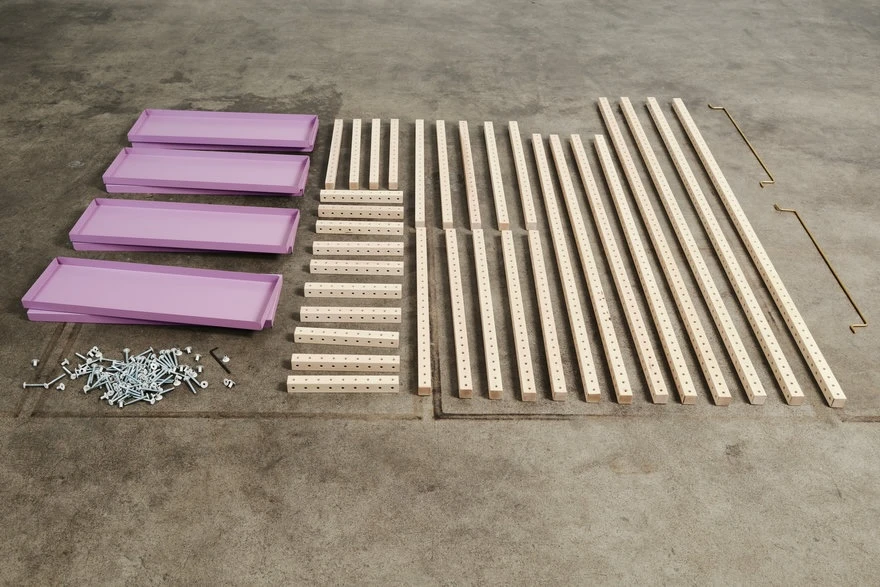
Pieces are built with simple hex screws and an Allen wrench using interchangeable solid-wood rails, flippable color-accented steel shelves or trays, and hanging rods.
mebl: Walk us through the evolution of this system over time.
Jennifer: I started with the kit of parts: wood rails, metal panels, nuts and bolts that followed standard parameters like table height and seat depth. I wanted to allow the user to create what they needed.
Then I started thinking – What if I used the kit of parts more sculpturally myself and showed users what’s possible? That became my OAK (Original Assembly Kit) collection, which I released in 2021. This was COVID-era, so people needed flexibility. I was thinking a lot about furniture that could adapt across different environments.
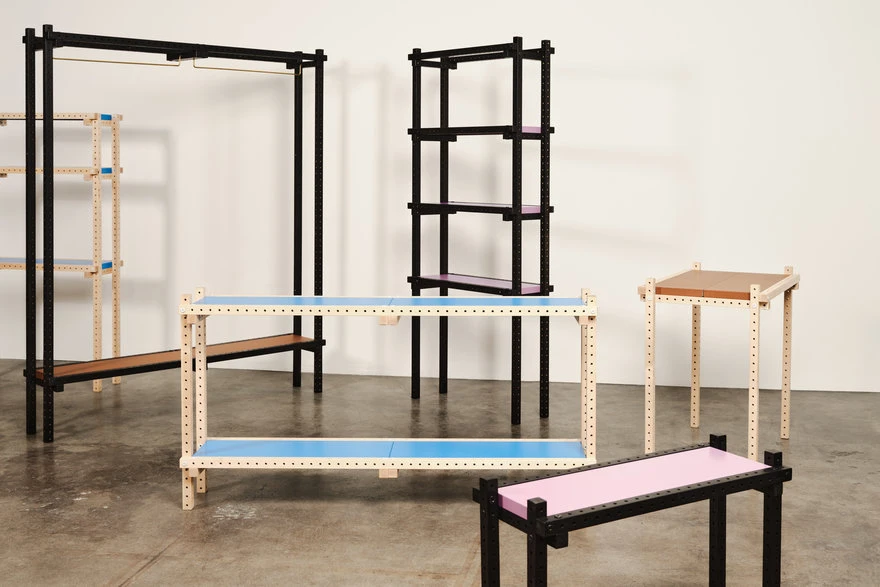
Loose Parts’ OAK Collection
mebl: Did you have an ‘AH HA!’ moment?
Jennifer: What followed was a real self-reckoning. I started thinking: there's already so much furniture out there, how do I actually compete in this marketplace? I love interior design, but I didn't want to keep contributing to the cycle of install, rip out, install, rip out. So my question became-- Why can't reversibility, which is already built into my system's ethos, exist elsewhere?
I began to look at homes differently, at spaces like kitchens and bathrooms that already operate on standardized systems and dimensions – and where cabinetry is most often composite or ply, nailed and glued together, with almost nothing salvageable.
It became less about "do we need more furniture" and more about how far I could push the system. Once it had a real application, my ability with joinery grew more sophisticated — a combination of improving my skill set, using better machinery and, finally, having a destination that felt clean and clear.
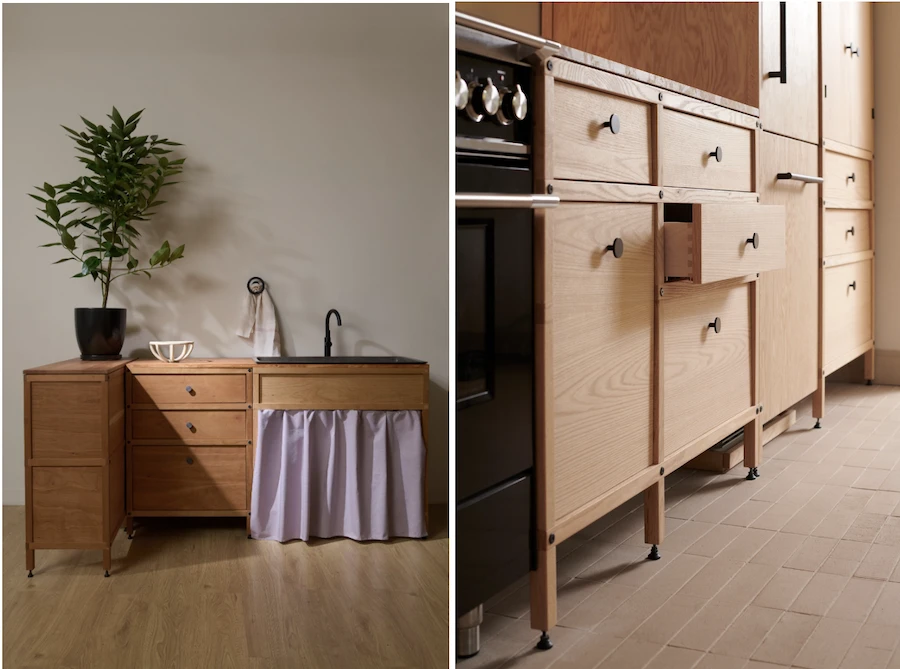
Loose Parts' kitchen line reimagines cabinetry as freestanding, modular furniture built to be repaired, refinished, and disassembled rather than ripped out and replaced.
mebl: What is Loose Parts today?
Jennifer: Loose Parts today specializes in handcrafted, modular, and freestanding furniture and, as of recently, kitchen systems - designed for disassembly, repair, and circular longevity rather than replacement.
mebl: What materials do you use?
Jennifer: I work a lot with solid and reclaimed wood from local mills. I'm lucky to live in the wood basket of the Northeast, with ready access to beautiful hardwoods like cherry, oak and maple. I also like using sheet metal and folding it in different ways to create rigidity for shelving.
All of these materials can be unbolted and either recoated or reused in another way. In the kitchens, the joinery is concealed but the system is still there – which allows for swapping different materials in and out.
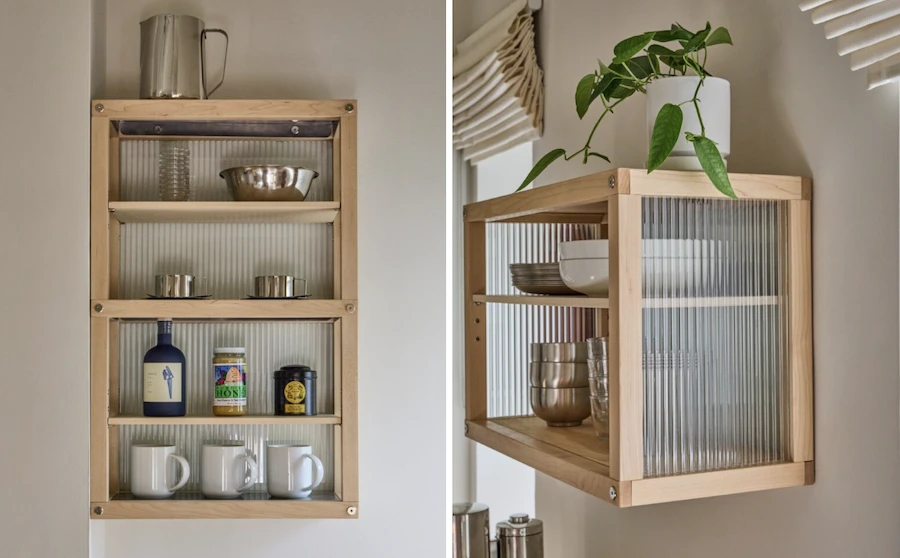
Loose Parts’ system allows for materials to be exchanged in and out as needs, or tastes, change.
mebl: Can we - excuse the pun! - drill down a bit-- What drew you to design for disassembly in the first place?
Jennifer: I didn’t initially intend to design a sustainable furniture system. I had to think in parts because my first studio was a small Brooklyn apartment. It couldn't handle large sheets of plywood and I didn't have a huge table saw – it was just me! So I had to think through an additive building process as opposed to starting with a big idea.
Over time, designing for disassembly started to make me rethink my timeline. When I primarily made furniture, I was thinking about assembly and reassembly across multiple short iterations. These days, with kitchens, I'm thinking about a longer lifespan — kitchens get renovated every seven to ten years — so the question became how to extend the use of the cabinets themselves.
Kitchen cabinets made of solid materials can be repaired and refinished, like in the old days. Then, at the true end of a kitchen's life, the materials can be disassembled and enter proper waste streams — recycled metals, reused hardware, composted wood.
mebl: Why is gluing everything still the norm?
Jennifer: It's easier and cheaper. Designing for disassembly takes more work upfront and higher material intelligence — you have to understand each material's properties. Wood moves. So you have to build a system in which that movement is permissible without structurally compromising the piece. However, if the industry would adopt reversible joinery, I think it would completely change the renovation and demolition process.
mebl: You also teach at Parsons School of Design. What’s surprised you about the next generation of designers?
Jennifer: I’ve noticed a completely different approach to materiality. I have a lot of students who make their own mycelium structures or their own bioplastics – signalling this willingness to generate and design from their own raw materials.
That's exciting because it's a different approach to design altogether — more about problem-solving, more DIY, more experimental. It's different from shopping for materials, or waiting for a company to release some innovative new one.
mebl: Your students lean into experimentation?
Jennifer: Yes, they are willing to experiment with new processes — even just getting to the point of thinking "I could use a bioplastic here," instead of defaulting to "this is the way it's always been done" or "these are the materials available to me." These are still small samples, of course. But it shows a real willingness to be more engaged in the process of design, and less fixated on the final product.
In general, the interior design program at Parsons emphasizes sustainability, so everyone is working toward that from the start. We used to, for example, use foam board for model making. Now there's a student-run material library where students bring scrap material and other students pull from it for model-making. Adhesives are discouraged across the board. It's baked into the culture from day one.
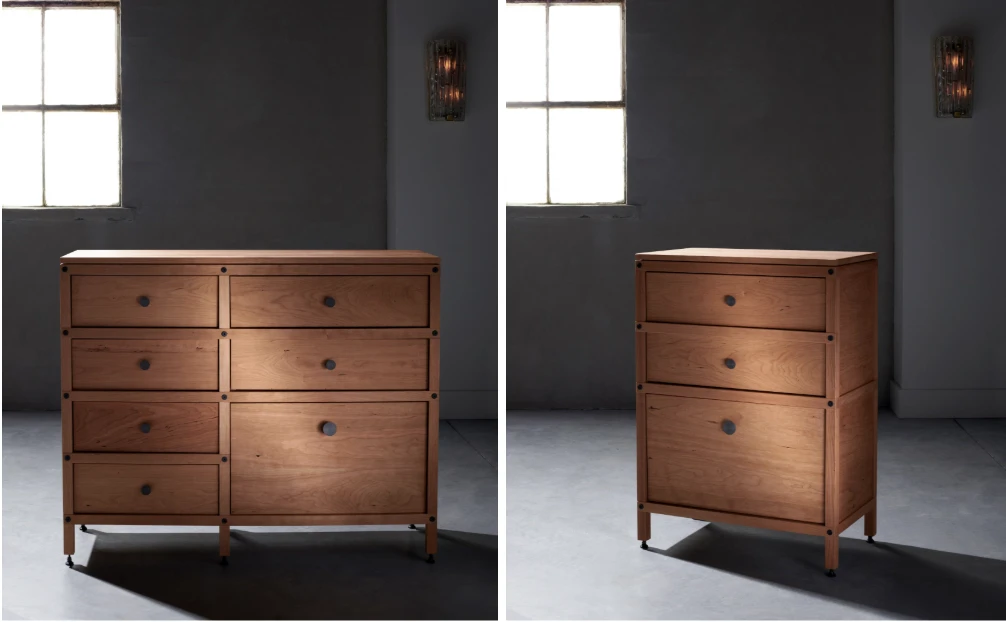
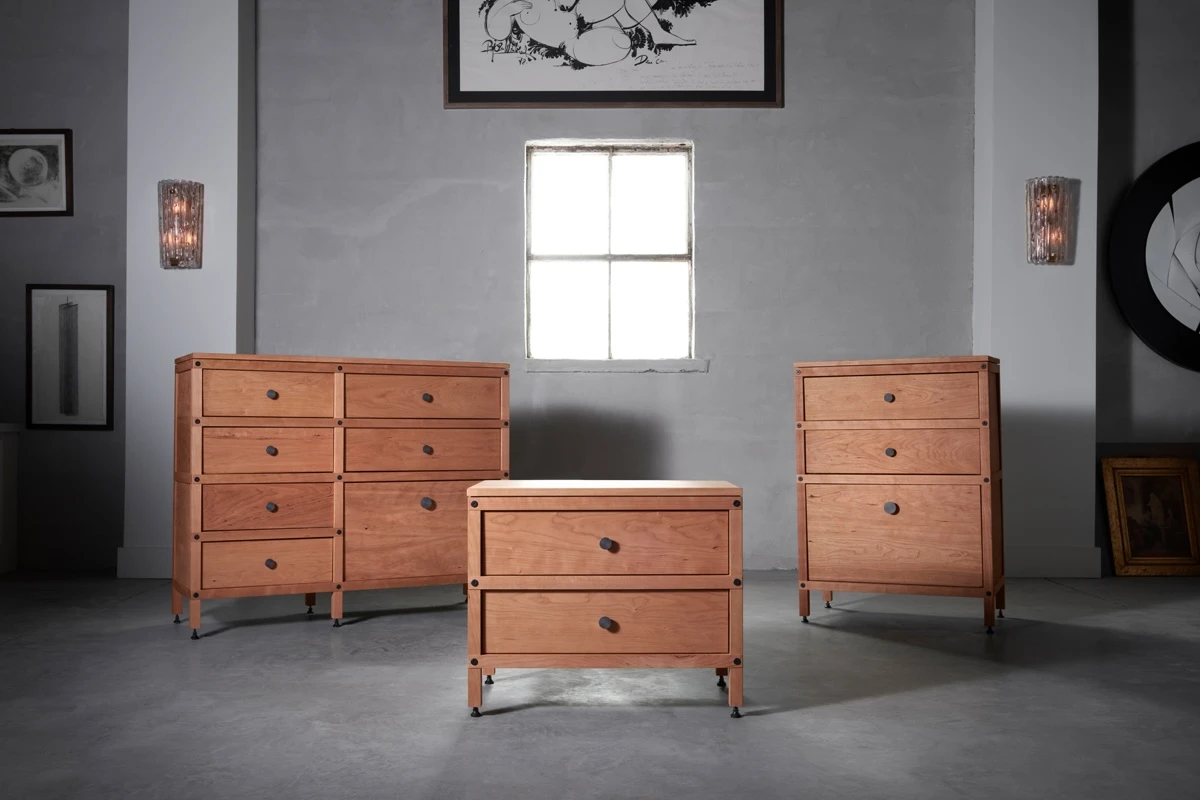
The Meridian Collection was the jumping-off point for Loose Parts' kitchen line — solid wood, exposed joinery, no adhesives, and freestanding modular units.
mebl: What do you think would accelerate the furniture/design industry’s transition towards circularity?
Jennifer: Greater transparency. I tell my students there are three key tenets: first, there's no "away" — a renovation doesn't make materials disappear, it just sends them to a landfill or an incinerator. Second, materials are always in motion-- they are extracted from somewhere, used briefly, and then go somewhere else. And, third, because of that, design should aim to keep objects at their highest and best value for as long as possible.
Anything in your home that’s older than you has stayed because it has kept its value — emotionally, structurally, or because the design still works. If more consumers, designers, and manufacturers understood that, it would change their approach from the very beginning.
mebl: Where do you see Loose Parts headed from here?
Jennifer: I want greater impact and reach, but not at the expense of our core ideals. Ideally, I’d like to have an ongoing relationship with clients, so they can come back to Loose Parts after several years and say, "we're moving," or "we want this kitchen cabinet to become a dresser," and we figure out together how to adapt it.
Right now, for example, I have a client – it's an organization – and we’re reusing old 1950s metal cabinets, combining them with the Loose Parts system, modernizing them for their space. It's not always Loose Parts’ wood-rail system that’s at the heart of what I do — sometimes it's the ethos and design problem-solving that matter most.
--> READ more Changemaker Interviews here.